TRADITIONS, BELIEFS AND NORMS OF THE MAASAI
Stories at the foot of Mt Kilimanjaro
LIFE INSIDE A MANYATTA
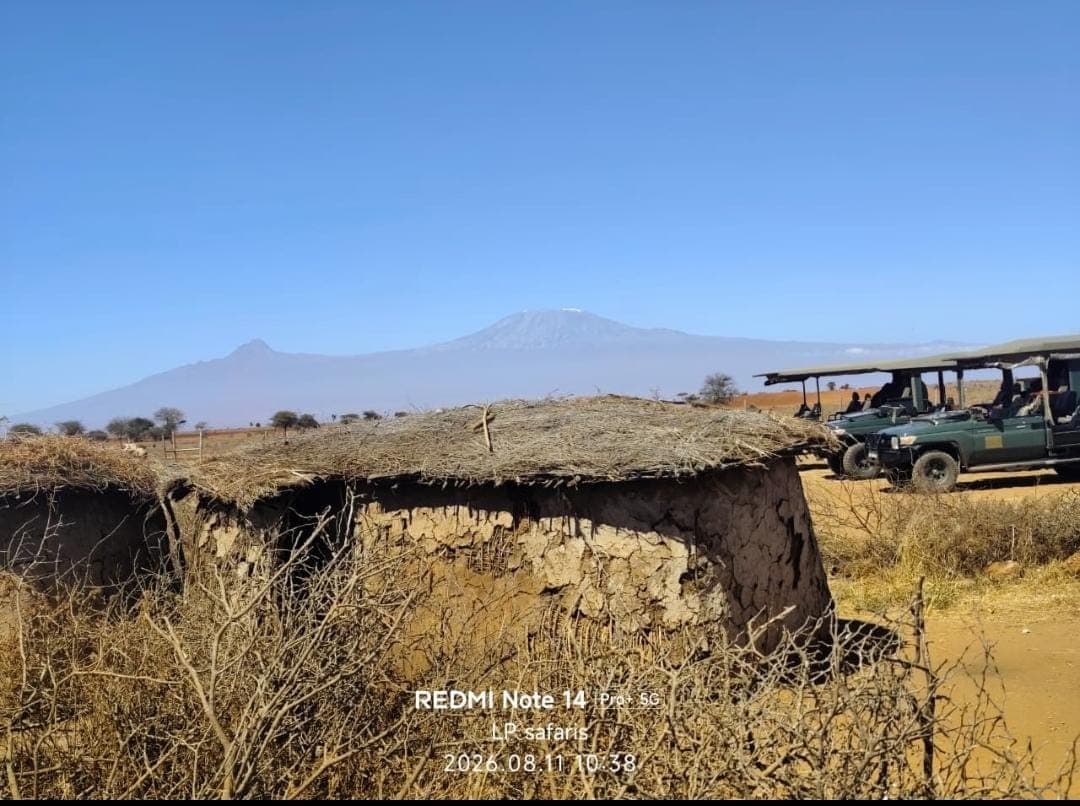
There is a spot I bring almost every guest to, just as the light softens over the plains and Kilimanjaro finally shakes off its morning haze. We stop the vehicle, step down onto the red Amboseli earth, and I point toward a low, round hut with a dome of dry grass and a wall of hardened mud and cow dung. Behind it, the mountain rises pale and enormous, snow still clinging to its cap even in the heat of the savannah below. This is where we shared our beliefs, values and norms of our people. It is our everyday habits and practices that pass down to generations — at the backdrop of Mount Kilimanjaro. I'm lucky to share these stories with my friends from all over the world.
The hut shown in the picture is called Enkaji — a Maasai home — and the cluster of homes around it, fenced in by thorny acacia branches to keep out lions and hyenas at night, is called Enkang. It is not just architecture. It is a way of remembering who we are.
THE HANDS THAT BUILD A HOME
Walk closer and you will notice something most visitors don't expect: it is the women who build the manyatta. A Maasai wife constructs her own house — bending young branches into a dome-shaped frame, weaving in dried grass, then plastering the walls by hand with a mixture of mud, water, cow dung, and ash. It can take weeks, sometimes months, and it is done without nails, without cement, without machinery — just knowledge passed from mother to daughter for as long as anyone can remember. The dung and mud walls aren't a sign of scarcity. They are engineering suited perfectly to this land: cool in the fierce midday heat, waterproof against the short rains, and durable enough to last for years. Inside, the house is deliberately small and dim, divided into little more than a sleeping area, a hearth for cooking, and sometimes a corner where newborn calves are kept safe overnight. Everything about it is built around one idea — protecting the family and the livestock that sustain it.
CATTLE, THE CURRENCY OF LIFE
To understand the manyatta, you have to understand cattle. For the Maasai, cows are not simply animals — they are wealth, dowry, food, medicine, and social standing all at once. Milk and blood, drawn carefully without harming the animal, have fed generations. A man's status in the community is often measured by the size of his herd, and the boma — the thorn-fence enclosure at the heart of every manyatta — exists first and foremost to keep that herd safe through the night. When you see young boys walking barefoot beside cattle across the plains, or a herder standing on one leg with a spear resting against his shoulder watching the horizon, you are watching a relationship between people and animals that stretches back centuries, still practiced exactly as it always has been.
THE MAKING OF A MORAN
No part of Maasai culture captivates visitors quite like the moran ,also known as the warrior. Boys pass through an age-set system that marks every stage of a man's life, and becoming a moran is one of the most important. After circumcision ceremonies that mark the passage from boyhood, young men enter a period as warriors: their duty historically to protect the community and its cattle, and today, increasingly, to also protect the wildlife that shares this land. Morans are easy to recognize — draped in bright red shúkàs, their hair often braided and dyed with ochre, beaded jewelry stacked at the neck and wrists, a spear or rungu (club) never far from hand. The famous adumu, the jumping dance performed shoulder to shoulder in a circle, isn't a performance for tourists first — it began as a display of strength and stamina, a way for young men to show their vitality within the community, long before any camera was pointed at it. (If you visit a manyatta with us, this is a moment I always try to arrange — watching morans perform the En'dumunoto themselves is something photographs alone can never quite capture.)
EVERYDAY RHYTHMS, SACRED MEANING
What strikes most guests, once they sit with a Maasai family inside the boma, is how ordinary and how sacred daily life is at once. Children herd goats before school. Elders gather to settle disputes and pass judgment under a tree that has served as a council ground for generations. Beadwork — each color carrying meaning, red for bravery and unity, blue for the sky and energy, white for peace and purity — is stitched by hand during quiet afternoons, often while stories are told. Naming ceremonies, weddings, and the blessing of cattle are all marked with songs and rituals that have never been written down; they live only in memory and voice, carried from grandmother to mother to daughter, from father to son. Standing inside a manyatta, listening to an elder describe a ceremony her mother once performed in this same spot, you begin to understand that the mud walls around you are really just a frame for something far more lasting — a living archive of a people's history.
WHY I BRING GUEST HERE
I grew up hearing these stories before I ever learned to tell them to visitors. Every time I lead a group to a manyatta at the base of Kilimanjaro, I'm doing more than showing off scenery — I'm handing over a small piece of something my grandparents handed to me. The thorn fence, the dung-walled hut, the red shúkà catching the wind, the mountain standing silent in the background — none of it is staged for tourism. It was here long before the first safari vehicle ever drove this road, and it will be here long after. So when you visit Amboseli, don't just photograph the manyatta from a distance. Step inside. Ask questions. Share a cup of tea by the fire. That's when the culture stops being something you observe, and becomes something you're invited into — even if only for an afternoon, at the backdrop of Africa's tallest mountain.
Traveling to Amboseli and want to experience a real Maasai manyatta visit — not a staged tourist stop? Get in touch and I'll build it into your itinerary.